Showing posts with label active galaxies. Show all posts

Monday, July 25, 2011

What activates a supermassive black hole?

There's good evidence that massive black holes exist at the centers of most large galaxies having a central bulge, and even within galaxies that lack a central bulge, are small, or have an irregular form. Such black holes can range in size up to more than 10 billion solar masses (M). Little is known about what the average or typical mass of a central black hole is, although most are probably a lot smaller, such as that of Sagittarius A* in our galaxy, which is only ~4.2×10⁶ M.

Four million solar masses is still pretty hefty, so such objects are usually called supermassive black holes (SMBHs), as opposed to black holes that form as supernova remnants and are only at most a few M. It's not known exactly how SMBHs form and evolve. One clue is that most seem to reside in non-dwarf galaxies with a regular shape and a noticeable central bulge. This suggests that SMBHs form and evolve in tandem with the bulge. However, there are exceptions, such as one discussed here: Supermassive black hole in a dwarf galaxy. Another survey of small (under 1010 M) inactive galaxies in the Virgo cluster found that at least 24% had an X-ray-emitting SMBH.

Since a black hole emits little or no radiation directly, even SMBHs are difficult to detect at distances of millions of light years, unless they are surrounded by a substantial amount of gas and dust that is heated enough in the process of falling into the SMBH that it can strongly emit radiation on its own or produce other detectable effects, like jets. Objects that fall in this category are active galactic nuclei (AGN). In most cases only SMBHs that are active as AGNs are readily detectable, so these are the only specimens we know much at all about.

I've discussed AGN a lot, most recently here, here, here, here, here.

In order to study how SMBHs form and evolve we pretty much have to rely on studies of AGNs, which can provide many clues about this issue. Unfortunately, we don't know much about what causes a relatively quiescent SMBH to become active and turn into an AGN. It's this latter question that's addressed, indirectly, by the research to be discussed here.

But first let's back up to SMBHs in general. There are several interrelated questions concerning their origin and evolution. What accounts for their formation and periods of rapid growth? Do they form before, after, or in parallel with the formation of the galaxies in which they reside? What stimulates their intense outbursts of energy as AGNs or quasars?

The most basic question is: What are the typical ways that SMBHs grow? Possible answers include merger between smaller SMBHs, slow but steady accretion of matter from the surrounding galaxy, or bursts of rapid accretion when substantial amounts of gas and dust are swept up by the SMBH.

Each of these questions, among others, stimulates intense debates among astrophysicists who study such things. These questions are interesting and important not just for their own sake. Since there is a lot of evidence that the evolution of a galaxy and of its central SMBH occur in tandem, understanding the evolution of the SMBH helps us understand that of the whole galaxy.

The research we're concerned with here was designed to study the question by surveying a large number of galaxies that can be examined in some detail because they are not too distant. In this case, that means having a redshift z≤1. That corresponds to a distance (measured in light travel time) of about 7.7 billion light years – a little more than half the size of the visible universe. Since the research needs to examine the visible form of the object, anything farther away is too distant for even the Hubble telescope to resolve in sufficient detail. Also, at z=1 all light from the visible part of the spectrum is shifted to infrared, which Hubble's optics aren't optimized for.

An AGN produces quite energetic radiation across most of the electromagnetic spectrum. So, at least in most cases, it is a sign of the rapid burst model of growth mentioned above. This is typically just a relatively short phase in the life of the galaxy-black hole combination – on the order of a hundred million years or so. That's based on the observation that only about 1% (very roughly) of large galaxies are in this phase, over the 13.7-billion year age of the visible universe. Whether this represents the only mode of growth, or even the bulk of it, is the big unknown. And of course, if there are SMBHs that grow by modes other than rapid accretion, we won't even detect them as AGN.

The standard model of AGNs, which is pretty well accepted by the astrophysical community, is that rapid accretion of interstellar gas and dust around a SMBH is what powers the AGN's "engine". Presumably, then, the AGN goes quiet when most of the available gas and dust has been consumed. But that leaves the question of what initiates the process in the first place. Since there are still many AGNs that are active in the universe out to z=1, so that the galaxies involved have been growing for at least 5 billion years since the early days of the universe, AGNs could not have been active for their entire lives. Therefore, something happened at some point to trigger the activity we observe now.

Astrophysicists want to know what that something is. At least initially, there is much more gas and dust spread throughout the galaxy than in the center. Something has to happen to cause that matter to lose its angular momentum so it can fall into the center. One popular hypothesis has been that this process is triggered by mergers between mature galaxies of roughly equal size, as the gas and dust perturbed by the merger falls inward and is swept up by the central black holes (which might merge themselves). Up until now, there has not been a large-scale investigation of this hypothesis.

Now we have one: The bulk of the black hole growth since z~1 occurs in a secular universe: No major merger-AGN connection. (Available at the arXiv: 1009.3265v2.)

A sample of 140 AGNs was selected for examination. Another sample of 1264 inactive galaxies, carefully matched in size, distance, etc. was also selected for comparison. The only reliable indication of an ongoing merger is a visible distortion of the object's shape, so this is taken as a proxy for the occurrence of a merger. However, the galaxies observed could be undergoing "minor" mergers that don't result in visible distortion (considering how far away most selected objects are). And on the other hand, there's no way to be sure that an object's observable distortion is due to a merger. So the conservative view is that this research is looking at the correlation between galaxy activity and distortion of shape.

There are two specific questions addressed by the research: (1) How many AGN have a distorted structure that appears to be the result of a galactic merger? (2) Do AGNs show any significant difference in terms of visible distortion from otherwise comparable inactive galaxies?

The first question is about whether mergers that produce distortions are a necessary condition for an AGN. Since fewer than 15% of AGNs have visible distortion, the answer is clearly "no". The second question concerns whether a merger that produces distortion is sufficient to trigger an AGN. Since there was no significant difference between AGNs and a control set of non-AGNs in terms of frequency of visible distortion, it seems that whatever causes a distorted form (such as a merger) is not a significant cause for triggering an AGN.

Bottom line: Not only are distortion-producing mergers unnecessary for triggering an AGN, they do not even seem to be a significant cause. One way to think of it is as a visible symptom of some underlying process that might otherwise be hard to detect. (A medical example would be a cancer, whose presence might be indicated by physical symptoms or biochemical markers in the blood.) In the present case, it appears that having a distorted form isn't a symptom usually exhibited by a galaxy when an AGN is present - and in fact, it doesn't predict the presence of an AGN at all.

It is important to be able to identify reliable symptoms, because a galaxy may have an AGN that is not readily detectable directly. Many AGNs are not intense radio sources, presumably because they do not have significant jet structures. And unless we are viewing the galaxy more or less face-on, radiation at shorter wavelengths can be blocked by a thick torus of gas and dust surrounding the central engine of the AGN.

Not all important questions are answered by this study. For example, galaxy mergers that do not significantly distort galactic structure – perhaps involving the cannibalism of a small galaxy by a large one – might play an important role in triggering an AGN.

The results of this research are surprising, because they seem to rule out distortion-producing galaxy mergers as an important cause of AGNs – the previous general assumption. However, it shouldn't be concluded that galaxy collisions can never produce AGNs, let alone SMBHs. There is still the question of whether a SMBH can form "from scratch" without some sort of "seed". It could be that very large black holes formed in the very first instants after the big bang, as "primordial" black holes. (See here, for example. Further possibility for the formation of seed black holes are discussed here.)

However, a simulation study reported last year in Nature (here) showed that in the early universe, SMBHs could form directly from galaxy collisions. But conditions at that time were very different – there was much more gas around that hadn't formed into stars, and a much larger single mass of gas could accumulate without forming stars. Time permitting, as usual, I'd like to discuss this research in another post.


This post was chosen as an Editor's Selection for ResearchBlogging.org
Cisternas, M., Jahnke, K., Inskip, K., Kartaltepe, J., Koekemoer, A., Lisker, T., Robaina, A., Scodeggio, M., Sheth, K., Trump, J., Andrae, R., Miyaji, T., Lusso, E., Brusa, M., Capak, P., Cappelluti, N., Civano, F., Ilbert, O., Impey, C., Leauthaud, A., Lilly, S., Salvato, M., Scoville, N., & Taniguchi, Y. (2011).
THE BULK OF THE BLACK HOLE GROWTH SINCE Z~1 OCCURS IN A SECULAR UNIVERSE: NO MAJOR MERGER-AGN CONNECTION
The Astrophysical Journal, 726 (2) DOI: 10.1088/0004-637X/726/2/57


Further reading:
  • Galaxy collisions may not fuel black holes after all (1/6/11)
  • Mystery Deepens in Origin of Violent Black Holes (1/5/11)
  • Galactic Smashups Leave Giant Black Holes Hungry (1/5/11)
  • Study: Hyperactive Black Holes Aren’t Caused by Galactic Smash-ups (1/6/11)
  • Collisions Cleared as Cause of Galactic Infernos (1/5/11)
  • Identity parade clears cosmic collisions of the suspicion of promoting black hole growth (1/5/11)

Tuesday, December 28, 2010

Recent research findings on M87 (NGC 4486)

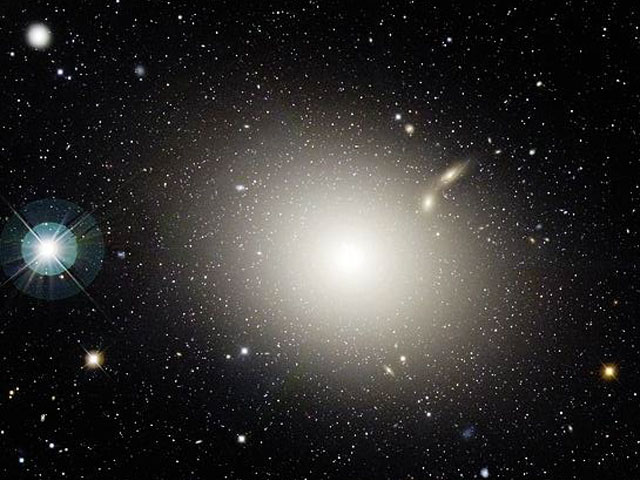
M87 (Messier 87), also known as NGC 4486, is a giant elliptical galaxy, located about 53.5 million light-years away. It is noteworthy for several reasons, including the presence of an unusually large supermassive black hole (SMBH) in its active galactic nucleus, with an estimated mass of about 6.4×10⁹ times the mass of the Sun (M), two plasma jets that emit strongly at radio frequencies and extend at least 5000 light-years from the SMBH (although only the jet pointed more towards us is readily detectable), and a population of about 15,000 globular clusters.

The total mass of M87 is difficult to estimate, because elliptical galaxies like M87, and unlike spiral galaxies, do not tend to follow the Tully-Fisher relation between intrinsic luminosity and total mass calculated from rotation curves – which therefore includes dark matter. Estimates of the total mass of M87, including dark matter, come in around 6×10¹² M within a radius of 150,000 light-years from the center. This compares with about 7×10¹¹ M for the Milky Way, but M87 could be more than 10 times as massive.

In other comparisons, the Milky Way has only about 160 globular clusters, and a central black hole (Sagittarius A*) with a mass of about 4.2×10⁶ M. So M87's central black hole is about 1500 times as massive as the Milky Way's. Pretty impressive difference.


M87 – click for 640×480 image


Besides the recent research listed below, I've written about earlier research on M87 in these articles: Galactic black holes may be more massive than thought, Stellar birth control by supermassive black holes, Black holes in the news.

You might also be interested in some articles from the past year on the general subject of active galaxies: Active galaxies and supermassive black hole jets, Where the action is in black hole jets, Quasars in the very early universe.


Feedback under the microscope: thermodynamic structure and AGN driven shocks in M87 (6/29/10) – arXiv paper

Feedback under the microscope II: heating, gas uplift, and mixing in the nearest cluster core (3/28/10) – arXiv paper

Activity of the SMBH in M87 has a significant effect not only on the host galaxy, but also on the Virgo cluster of galaxies in which M87 is near the center. Energetic outflows of matter from near the black hole force plumes of gas out of the galaxy into the hotter intergalactic medium. The mass transported in this way represents about as much gas as is contained within 12,000 light-years of M87's center. (However, that's only about 2.5% of M87's 500,000 light-year radius.) If it had not been expelled, the gas could have formed hundreds of millions of stars.

The first paper reports on studies using the Chandra X-ray Observatory to measure gas temperatures around M87's center. The findings include detection of 2 distinct shock wave fronts about 46 thousand light-years and 10 thousand light years from the center. This indicates that explosive events occurred about 150 million and 11 million years ago, respectively.

The second paper uses observations from Chandra, XMM-Newton, and optical spectra to distinguish different phases of the hot gas surrounding M87's SMBH.

Refs:
Galactic 'Super-Volcano' in Action (8/20/10) – Science Daily (press release)
Galactic Supervolcano Erupts From Black Hole (8/20/10) – Wired.com
Galactic 'Supervolcano' Seen Erupting With X-Rays (9/6/10) – Space.com

A correlation between central supermassive black holes and the globular cluster systems of early-type galaxies (8/13/10) – arXiv paper

A study of 13 galaxies, including M87, has found a correlation between the size of a galaxy's SMBH and the number of the galaxy's globular clusters. The types of galaxies studied included nine giant ellipticals (like M87), a tight spiral, and 3 galaxies intermediate in type between spiral and elliptical. The smallness of the sample is due to the exclusion of open spiral galaxies and the further limitation to cases where good estimates of the number of globular clusters and mass of the central black hole existed.

The correlation, in which the number of globular clusters is proportional to the black hole mass, is actually stronger than correlations between black hole mass and other galaxy properties previously studied for correlation, such as stellar velocity dispersion (an indicator of total mass), and luminosity of the galaxy's central bulge or whole galaxy (for ellipticals).

In some cases the correlation of black hole mass with total luminosity was especially weak, but better with number of globular clusters. For instance, Fornax A (NGC 1316) is a giant lenticular galaxy with luminosity comparable to that of M87. Yet its central black hole has a mass of 1.5×10⁸ M, 2.3% that of M87's black hole. It has 1200 globular clusters, 8% of M87's count. Clearly this is not a linear relation. Rather, the study found that the best fit was a power law with M ≈ (1.7×10⁵)×N1.08±0.04, where M is black hole mass in units of M and N is number of globular clusters. This relation predicts a SMBH mass of 5.5×10⁹ M for M87, which is very close, and 3.6×10⁸ M for the SMBH mass of NGC 1316, which is high – but the SMBH mass of NGC 1316 is also unusually low in comparison with its luminosity and velocity dispersion.

By contrast, the relation predicts that the Milky Way with a SMBH mass of 4.2×10⁶ M should have only about 20 globular clusters, while the actual number is about 160. However, the Milky Way is a loose spiral, not one of the types that was studied, which may account for the much worse correlation. The fit is much better if only globular clusters associated with the central bulge (about 30) are considered.

The obvious question is about why this relation between SMBH mass and number of globular clusters exists. Presumably it has much to do with the typical history of a large galaxy, which is expected to include frequent mergers with other galaxies. The existence of the relationship should provide clues to galactic history, and especially how this may be different for loose spirals like the Milky Way, in comparison with more compact galaxies.

Refs:
A correlation between central supermassive black holes and the globular cluster systems of early type galaxies (8/11/10) – The Astrophysical Journal
Supermassive black holes reveal a surprising clue (5/25/10) – Physicsworld.com

A Displaced Supermassive Black Hole in M87 (6/16/10) – arXiv paper

It has generally been assumed that a galaxy's central SMBH is very close to the actual center of mass of the galaxy, because that is (by definition) the gravitational equilibrium point. This central point should be essentially the same as the photometric center of the galaxy, since the galaxy's stars should be distributed symmetrically around the center. Consequently, astronomers have not carefully searched for cases where a SMBH is not very near the galactic center. This lack of extensive investigation is also a result of the fact that the SMBH is often hidden inside a dense cloud of dust, so its exact position is difficult to determine. M87's SMBH (more precisely, the accretion disk around the SMBH), however, is clearly visible, and the research reported in this paper finds it is actually located about 22 light-years from the apparent galactic center.

There are various possible reasons for this much displacement from the center, and not a lot of evidence to identify the most likely reason. Possible reasons include: (1) The SMBH is part of a binary system in which the other member is not detected. (2) The SMBH could have been gravitationally perturbed by a massive object such as a globular cluster. (3) There is a significant asymmetry of the jets. (4) The SMBH has relatively recently merged with another SMBH, subsequent to an earlier merger of another galaxy with M87.

The displacement of the SMBH is in the direction opposite the visible jet, so the last two possibilities are more likely than the others. However, possibility (3) depends on the jet structure having existed at least 100 million years and the density of matter at the center of M87 being low enough to provide insufficient restoring force. Possibility (4) is viable if the SMBH is still oscillating around the center following a galactic merger within the past billion years.

Refs:
A Displaced Supermassive Black Hole in M87 (6/9/10) – The Astrophysical Journal Letters
Black Hole Shoved Aside, Along With 'central' Dogma (5/25/10) – Science News
Black Hole Found in Unexpected Place (5/25/10) – Wired.com
Supermassive black holes may frequently roam galaxy centers (5/25/10) – Physog.com (press release)
Bizarre Behavior of Two Giant Black Holes Surprises Scientists (5/25/10) – Space.com
Galactic Black Holes Can Migrate or Quickly Awaken from Quiescence (5/26/10) – Scientific American


M87 jet


Radio Imaging of the Very-High-Energy γ-Ray Emission Region in the Central Engine of a Radio Galaxy (7/24/09) – Science

Energetic plasma jets, in which matter is accelerated close to the speed of light, combined with intense electromagnetic emissions, especially at radio frequencies, are prominent in about 10% of active galaxies, including M87. However, little has been well established about what processes are responsible for the emissions, or more generally how the jets are powered, accelerated, and focused into narrow beams. Because of the relative proximity of M87 and the fact that the jet we observe is angled from 15° to 25° to our line of sight, M87 is one of the best objects to study in order to learn more about how jets work.

Gamma rays, because of their very high energies (greater than 100 keV per photon), are not continuously produced in active galaxy jets, but are occasionally observed in short bursts lasting only a few days. One such event occurred in M87 in February 2008. At the same time, the intensity of radiation at all other wavelengths increased substantially. Such flares, at lower energies, are not unusual, since the energy output of most jets is somewhat variable in time. The flare persisted for much longer at energies below the gamma-ray band, indicating that the disturbance continued to propagate along the jet even after the gamma-ray flare subsided. However, although we don't know what the cause was, the coincidence in time of the gamma-ray emissions and the beginning of the extended flare makes it very likely that the events had the same source.

This is significant information, because our technology for detecting gamma-ray events has very poor angular resolution (~0.1°), since gamma rays can be detected on the ground only by secondary effects that a gamma ray produces in our upper atmosphere. More than 6 orders of magnitude finer resolution can be achieved at radio frequencies, using very long baseline interferometry. With that technology, it was possible to locate the origin of the disturbance that caused both gamma ray and lower energy flaring to a region within about 100 Schwarzschild radii (Rs) of the SMBH. Since Rs = 2G×M/c2, Rs for the M87 SMBH is about 1.9×10¹⁰ km, or more than twice the radius of the solar system. So 100Rs is about 70 light-days – which is pretty small compared to the 53.5 million light-year distance to M87.

It's also significant that the gamma-ray event occurred so close to the SMBH, because the cause must be unlike whatever is responsible for the flaring described in the following research.

Refs:
VLBA locates superenergetic bursts near giant black hole (7/2/09) – Physorg.com (press release)
Mysterious Light Originates Near A Galaxy's Black Hole (7/2/09) – Space.com
A Flare for Acceleration (7/24/09) – Science
High Energy Galactic Particle Accelerator Located (9/14/09) – Science Daily (press release)

Hubble Space Telescope observations of an extraordinary flare in the M87 jet (4/22/09) – arXiv paper

Electromagnetic radiation from SMBH jets is fairly variable in both time and location along the jet. In the case of M87, high-resolution images at various wavelengths have shown the existence of many regions of enhanced emissions within the jet. One of the most prominent of these even has a name: HST-1, so-named because it was discovered by the Hubble Space Telescope. It occupies a stationary position on the jet, about a million Schwarzschild radii from the center, i. e. about 2000 light-years from the SMBH.

HST-1 has been observable for some time, but until February 2000 it was relatively dormant. After that it began to flare more brightly across the electromagnetic spectrum up to X-rays. In 2003 it became more variable, and it reached its greatest brightness in May 2005, when the flux in near ultraviolet was 4 times as great as that of M87's central energy source, the SMBH accretion disk. This represents a brightness increase at that wavelength of a factor of 90. The X-ray flux increased by a factor of 50, and similar, synchronized changes occurred at other wavelengths. The synchronization indicates that one mechanism is responsible for the variability at all wavelengths.

What the actual cause of the disturbance may be is not clear. Because of the great distance of HST-1 from the SMBH, its basic energy source must not be the central accretion disk itself. More likely HST-1 is a result of constriction of magnetic field lines, resulting in further acceleration of the particles making up the jet. Acceleration of charged particles causes radiation by the synchrotron process, and is evidenced by polarization of the emitted photons. Constriction of the jet may be a result of passage through a region of higher density of stars. The increased variability could mean that the jet has encountered a region of higher but varying stellar density. Alternatively, the jet may be passing through a patch of thick gas or dust, with excess radiation produced by the resulting particle collisions.

These results could explain the variability of light from other, more distant active galaxies, at least those which have strong jets, given that it's possible for a small region of the jet far from the SMBH to outshine the central source. However, another source of variability occurs when a jet is viewed at a very low angle to our line of sight, in which case any slight change of direction could cause an apparent change of brightness.

Refs:
Hubble Space Telescope observations of an extraordinary flare in the M87 jet (3/6/09) – The Astronomical Journal
Hubble Witnesses Spectacular Flaring in Gas Jet from M87's Black Hole (4/14/09) – Physorg.com (press release)
Black Hole Creates Spectacular Light Show (4/14/09) – Space.com
Black hole jet brightens mysteriously (4/15/09) – New Scientist
Black hole spews out impressive light show (4/20/09) – Cosmos Magazine